
Weird Taxes
15 December 2018 – 19 May 2019

Urine, slaughter, chimneys, windows, sugar, wigs, servants, newspapers, bachelors – you name it, it’s been taxed! These taxes seem weird to us, but placed in their historical context, they’re not so strange after all. Based on stories told about each tax, visitors could decide if a tax was just weird or had been cleverly devised to obtain revenue in a simple way, or to influence behaviour or achieve fair taxation.
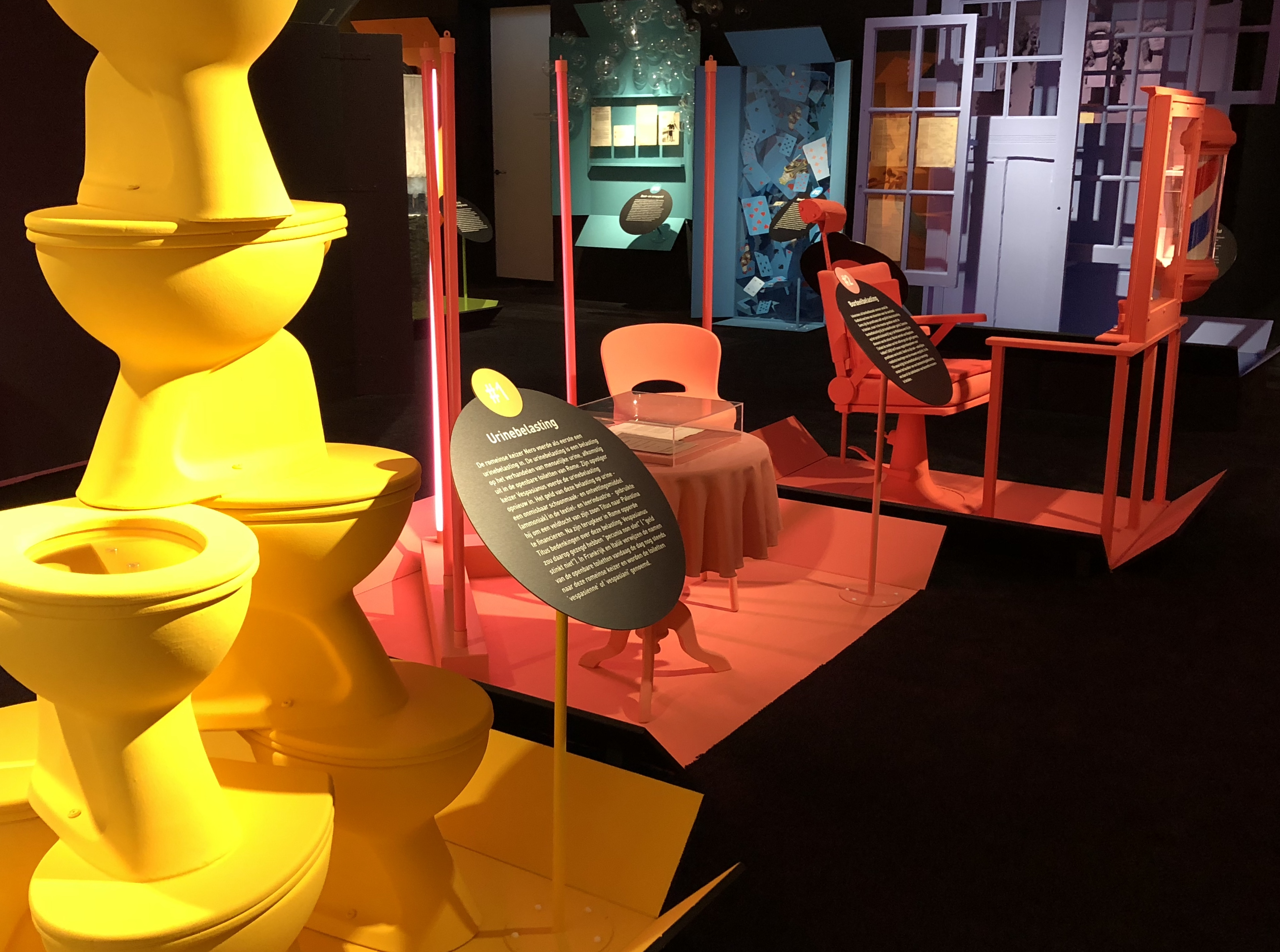
The exhibition
Twenty of the strangest taxes were given a modern twist in this exhibition. In the colourful cabinet of curiosities, visitors could go on a tour of discovery through peculiar taxes – levied in the Netherlands and beyond – from bygone times. Below is a selection from the top 20 weird taxes.
Urine tax
Emperor Vespasian introduced the urine tax around 69 CE for purely financial reasons. At that time, urine was an indispensable cleaning and degreasing agent. It was collected in Rome’s public toilets and sold to laundries. The emperor saw an opportunity and started taxing urine. Thanks to this tax, the expression ‘money doesn’t stink’ (pecunia non olet) is ascribed to Vespasian.
Beard tax
Tsar Peter the Great introduced this tax in 1689. His aim was to get Russian men to shave off their beards. The tsar thought beards were both unhygienic and old-fashioned. After a long visit to Western Europe, he decided to modernise his Russia. In addition to speaking French and wearing expensive clothing, this included shaving off those bushy Russian beards. To add force to the move, Peter the Great introduced the beard tax.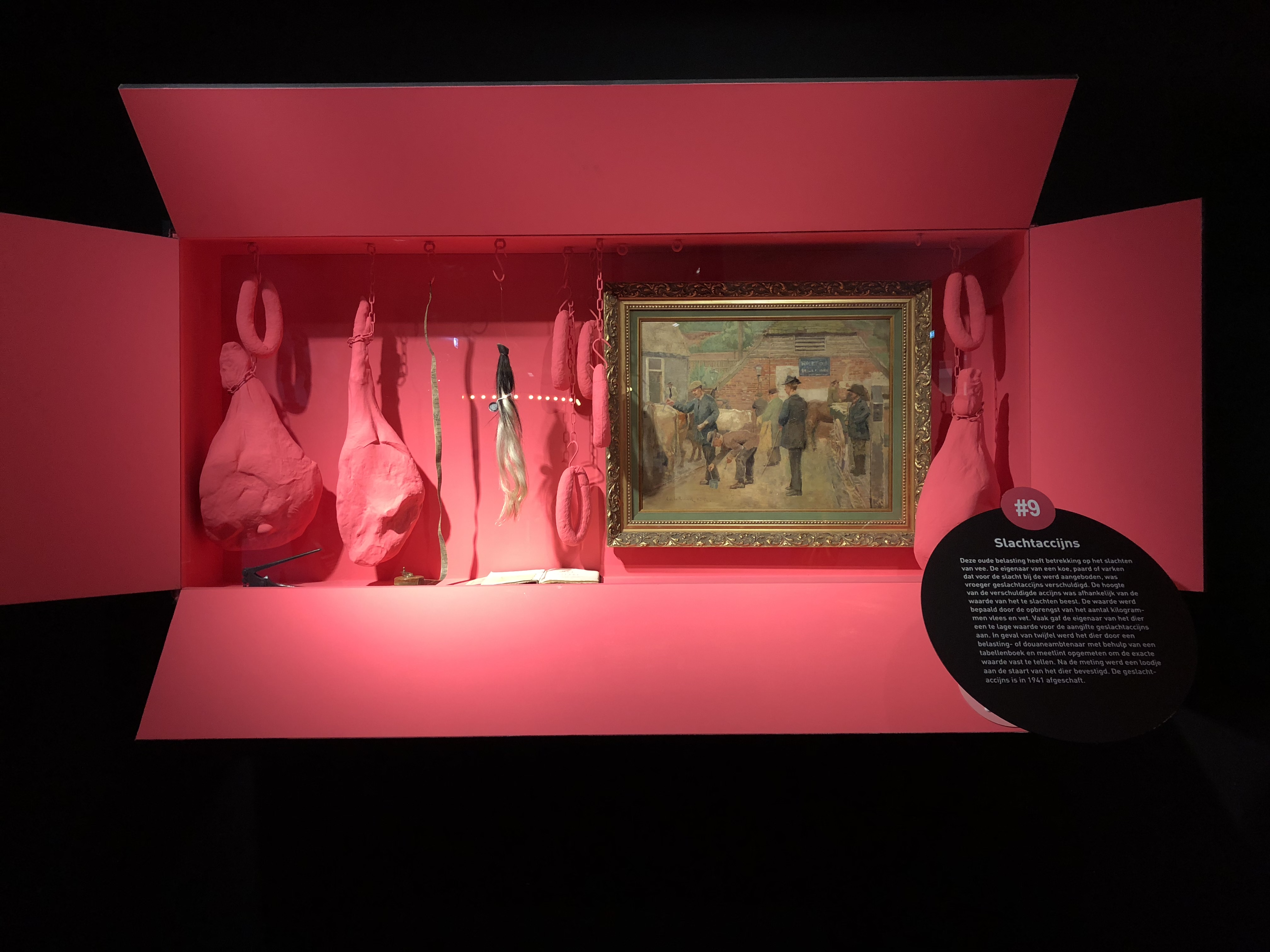
Slaughter excise duty
This old tax on the slaughter of livestock dates back to the late 16th century. Owners of cows, horses and pigs had to pay slaughter excise duty on the value of the animal (the yield in kilos of meat and fat). To check this value, the animals were sometimes measured by a tax official or customs officer. This was done using a tape measure and a book of tables. After the measurement, a lead seal was attached to the animal’s tail. The slaughter tax was abolished in 1941.
Licence to wear hair powder
In the early 19th century, when the Netherlands was under French rule, a national tax on luxury goods, including wigs, was introduced. It was fashionable at the time to wear wigs, they were expensive and worn by the wealthy. The wigs were powdered white every day and a tax had to be paid on that white hair powder. Those wearing wigs had to be able to show a licence as proof that the tax had been paid.
Tax on windows and doors
During the French period, a tax was also levied on the doors and windows of houses. This was a convenient way to determine the size and value of houses, and thus of someone’s property. The more windows, the higher the tax to be paid. Makes sense, right? People began bricking up windows to reduce their tax assessment and houses were built with as few windows as possible. At the end of the 19th century, this tax was abolished because it was having a detrimental impact on people’s health.
House servant and gentleman’s tax
Having house servants was also taxed a few centuries ago. Initially, this tax was called the gentleman’s tax but later it was replaced by the house servant tax (1636). Only people who had a lot of money could afford domestic staff. Therefore, it was considered reasonable at the time to tax those people for having servants. The more staff, the higher the tax. This tax was abolished in 1816.
Marriage and burial taxes
From 1695, you were liable to pay tax upon marriage and death. The rate had to be paid twice if you married or were buried outside your own municipality: once in your own municipality and once in the municipality where the event took place. The tax rate depended on your income. These days, we also pay fees to the municipality for marriage or burial, but these amounts are much lower if seen as a percentage of income.
Newspaper tax
Newspaper stamp duty was introduced in the 19th century. There was much opposition to it, as it made newspapers about 1.5 times more expensive. In 1867, there was even an Anti-Newspaper-Stamp-Duty League established in Rotterdam, as they viewed the tax as an impediment to the freedom of the press. In the end, newspaper stamp duty was abolished in 1869 and newspaper sales increased dramatically. The stamps on the upper corner of the front page of newspapers were nicknamed ‘the dirty fingers of the taxman’.
Bachelor tax
From ancient times to the 20th century, a tax on bachelors was regularly introduced or proposed. In Italy, the Roman emperor Augustus and the dictator Mussolini both tried to use this tax to entice citizens to marry in order to stimulate population growth. In the Netherlands in the 19th century, there was talk of introducing a bachelor tax because being a bachelor was said to be ‘immoral’. In 1935, Finance Minister Oud proposed a bachelor tax, but his plan did not pass in the House of Representatives.